Thursday, November 28, 2013

It's Called the Rainforest for a Reason


Last week, I had an excellent three-day visit to the Nilmini Tea Estate, an organic and labor friendly estate next to the Sinharaja Rainforest. In addition to tea, the estate grows spices and has a small paddy field, a vegetable garden, and lots of fruit trees. Needless to say, I ate very well while I was there, and, of course, drank an unbelievable amount of tea. I got a tour of the estate and tea factory from some of the workers who live in the nearby village, and although my tour guides deemed me unfit to walk in some of the more forested areas, it was still enjoyable.

The northeast monsoon is late this year, so although it should be over by now, this is actually one of the rainiest times, and it rained every afternoon that I was at Sinharaja. Within the course of about one hour, the weather would change from hot and sunny to overcast to a light drizzle to rain so loud that carrying out a conversation was a challenge (as if speaking in a foreign language isn’t hard enough). The owner explained to me that every day the rain starts earlier and ends later until eventually it doesn’t stop for about two weeks. Of course, the rain brings with it one of my least favorite animals (see my post from October 26, 2011), and as the owner of the estate asked me within a few hours of my arrival, “What’s a rainforest without leeches?” At least I’m starting to get used to them and am getting much better at flicking them off of my legs.
Nilmini Estate. The blue building in the background is the tea factory and the tea is growing in the shade of the fruit trees.

I’ll be returning to Nilmini in January, once the monsoon is over, for a longer visit and to see some of the surrounding villages with their home gardens and other nearby tea producers. In the meantime, I’m trying to improve my Sinhala and Tamil to better communicate with everyone at the estate, who with a few exceptions speaks almost no English. I’m also still working on finding one or two other sites that I might be able to compare to Sinharaja.

This past weekend, Anna and I went to Horton Plains National Park to go hiking. Our plan was to take the train to Ohiya, find a place to spend the night, walk the 11 km along the road to the park entrance, hike the 9 km loop past World’s End look out and Baker’s Falls in the park, and continue walking down the road to the train station in Pattipola, also about 11 km from the entrance. We got off the train at Ohiya just as it was starting to rain and saw a sign for a guesthouse, so we started walking down the road. We quickly realized that Ohiya is not actually a town but is really just a road with a train station. We ran into a couple walking the other direction who told us they were spending the night at a small guesthouse next to the train station. We continued walking but eventually decided to return to the train station where we learned that Ohiya consists of more than we had originally thought—there is also one house that has a small store, a restaurant, and a few rooms for rent. It was a very enjoyable night with homemade rice and curry and a friendly Sri Lankan family wanting us to stay for the month and teach their children English.

We got an early start the next morning, as we knew we had a lot of walking ahead of us. The one trishaw driver in town wanted to give us a ride to the park entrance, but we chose to walk and were rewarded with some incredible views. 


Our guesthouse with the town trishaw out front

Ohiya train statin

The entire town of Ohiya with the station on the right and the guesthouse/store/restaurant on the left

Some deer in Horton Plains

Baker's Falls

The view along the road connecting Ohiya and Pattipola

Sri Lankan Thanksgiving: curried macaroni and cheese, cucumber and tomato salad, pumpkin (more like squash) pie, and coconut/pumpkin/pear sauce


Thursday, October 31, 2013

My Month in Colombo


I’ve finally started to make some progress figuring out the details of where I will be and what I will be doing for my research project, which is good considering the fact that my month in Colombo is coming to an end. I plan to start by studying land use around the Sinharaja Rainforest, the largest remaining tract of rainforest in Sri Lanka. My main contact in Sri Lanka has offered to put me in touch with an economist who owns an organic tea estate close to Sinharaja and is working to make tea production sustainable and compatible with conservation of the rainforest. I hope to learn about what he is doing and how other people are managing land in this area. I’ll see where the research takes me, but right now, I’m thinking I then may want to do a comparative study looking at land use around a different protected area somewhere else in the country.

In addition to this preliminary research, I’ve had some time to get to know Colombo, and despite my initial dislike of this city, I’ve had an enjoyable month. All of us Fulbrighters went to a reception at the Fulbright Commission early in October, where we met some Sri Lankans about our age, who have been showing us around the city and even spent a weekend with us in Mirisa on the southern coast. Even though Mirisa is on a protected inlet, I was reminded of just how rough the Indian Ocean is, as the waves pushed me over, and I swallowed large amounts of sea water.

Last week Anna, Kelsi, and I started going to a fitness class that happens in the evenings in a park in Colombo (being outside is nice, but the heat and humidity make excessive physical activity challenging even after dark). Coincidentally, the leaders of the class are coaches at the Colombo Rowing Club, which was very exciting for Anna and me, both former rowers. They invited us to a regatta last weekend, and we even got to row in a double this morning!

Other highlights include the Good Market, a weekly market with fresh produce, crafts, and food from all parts of the world. It’s great to be able to buy a falafel sandwich, frozen yogurt, and coconut roti with lunu miris (chilies and onions) all at the same place.  Continuing on the food theme, fresh fruit juice has become a staple of my diet. I particularly enjoy the papaya, passion fruit, avocado, and wood apple juices. For those of you who don’t know what a wood apple is, check out this website: http://www.organicfacts.net/health-benefits/fruit/health-benefits-of-wood-apple-or-bel-fruit.html and here’s a picture: http://en.wikipedia.org/wiki/File:Wood-apple_dec2007.jpg. Don’t let the picture fool you, it’s actually quite delicious, and the health benefits are pretty impressive.

This is the house I've been living in for the past month


Some beach pictures.

Walking down the streets of Colombo

Oktoberfest in Colombo (don't be fooled by the German outfits--they're actually British)

Anna and me on the bus. We were lucky to get a seat--sometimes on buses and trains, there's barely room to stand.

The regatta between Royal and St. Thomas High Schools at the Colombo Rowing Club


Saturday, October 5, 2013

I'm Back

I finished my last post (written almost 2 years ago) by explaining the meaning of “gihin ennan,” literally translated as, “I will go and come,” and used as the Sinhala expression for good bye. When I left Sri Lanka after spending four months here with the ISLE Program, I longed to come back, a dream that at first seemed impossible in the short term, then slowly began to feel attainable as I put together my Fulbright application last fall, and ultimately became a reality after I heard last spring that I had received a student research Fulbright to model land use in the Sri Lankan hills and study the environmental impacts of upcountry agriculture on the country’s water resources. I spent the following six months going back and forth between excitement and nervousness as I finalized my travel plans.

I arrived here early Sunday morning after a long journey with two other Fulbrighters, Alex, who was here with me in 2011, and Hunter. I’m staying in Colombo for one month, taking language classes with some of the other Fulbrighters and preparing for my research. We took a trip to Kandy earlier in the week, where I got to visit my host family and the ISLE Center and was reminded of how much I loved being in this country. Now that I’m back in Colombo, I’m anxious to return to Kandy, where it is noticeably cooler, I am familiar with the city, and there are people I want to visit.

Now that our orientation is over, I'm starting to make plans for my research.  I’ve realized that, given my experience and language skills and the challenges of traveling in this country, the project I designed last fall will be nearly impossible. I have yet to figure out exactly what I will be doing, but I’m reaching out to my contacts here and hope that soon I will at least know how to start my research. In the meantime, I will continue to read and think about sustainable agriculture in Sri Lanka as I recover from my jetlag and culture shock.

Thursday, January 5, 2012

Gihin Ennan


The two weeks spent in Sri Lanka traveling with my family were unbelievably different from my previous four months there. We were traveling on the same windy roads, so it still took a long time to get anywhere, and, like before, it was impossible to know what to expect when we arrived at a new place, but it was amazing for me to realize how much easier it is to be a tourist than to live there. However, this may also have something to do with the fact that I could rely on other people (i.e. my parents) to make all the plans.
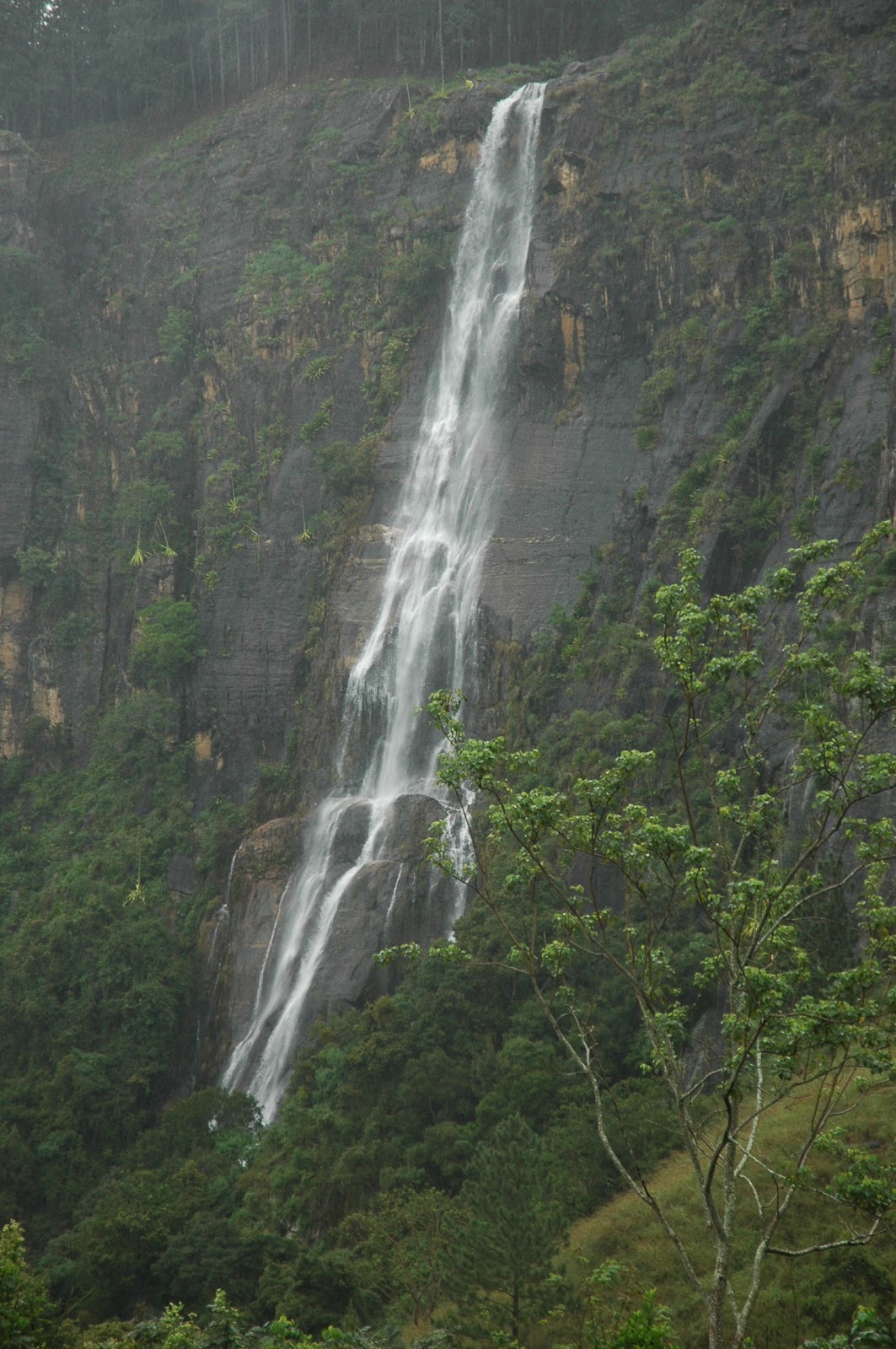
We started our vacation at the beach in Tangalle (disappointingly not as nice as the beaches I had been to in Hikkaduwa and Unawatuna), then made our way up into the hill country. Not realizing what we were getting in to, we took a slight detour up an incredibly narrow, winding road to a tiny guesthouse next to Bambarakanda Falls, the tallest waterfall in Sri Lanka, where, despite the rainy weather, we went hiking. I remembered the lesson from Hantana and wore close-toed shoes, but still the leeches managed to find their way onto my ankles and legs.
Tangalle

Bambarakanda Falls

Saying good bye to my family in Nuwara Eliya

After a couple days in the small village of Ella, we visited the family I stayed with in Nuwara Eliya and then made our way to Kandy. We saw some Kandyan dance shows, visited the Maligava (Temple of the Tooth), and walked up the hill to the large Buddha statue overlooking the city. What is more memorable than this sight-seeing, however, was Christmas Eve dinner at the Queen’s Hotel, complete with food ranging from rice and curry to sushi to roast turkey to a “U. log” for dessert, a dancing Santa Clause who handed out candy bars, a live band playing a 20 minute version of Jingle Bells, and center pieces that burst into flame at various points throughout the evening. It was a Christmas like no other.
For me, the most meaningful part of the visit to Kandy was saying good-bye to the people I had met there. I visited the ISLE Center, one of my professors, and finally my host family. As I’ve said before, nothing is easy in Sri Lanka, but these farewells, particularly to my host family, were some of the hardest parts of the semester, and were definitely the saddest.
Here I am with some (not all) of my host family and American family

After leaving Kandy, we went up to the Cultural Triangle to see the ruins at Sigiriya, Polonnaruwa, and Dambulla. We also spent a day at the Beach in Trincomalee (much less developed than the beaches in the south) and saw several herds of elephants by the side of the road—an incredible sight!
Wild elephants!

I got home a few days ago and am already Sri Lanka sick and miss my host family (parents, aunts, uncles, cousins, neighbors, and everyone else) a lot. In the end, they really felt like my family. In Sinhala, there is no word for “good-bye.” Instead people say, “Gihin ennan,” which means, “I will go and come,” implying that the good-bye is not forever. My time in Sri Lanka is over for now, but I hope that someday I will be able to go back and visit. Gihin ennan.

Friday, December 16, 2011

Stairs and Sarees

It’s over. The ISLE Program has officially ended. I’ll admit, the first few weeks here dragged on FOREVER, but for the most part, the past 16 weeks have flown by. Turning in my independent study was a strange feeling—my obligations were finished, but the fun was not.
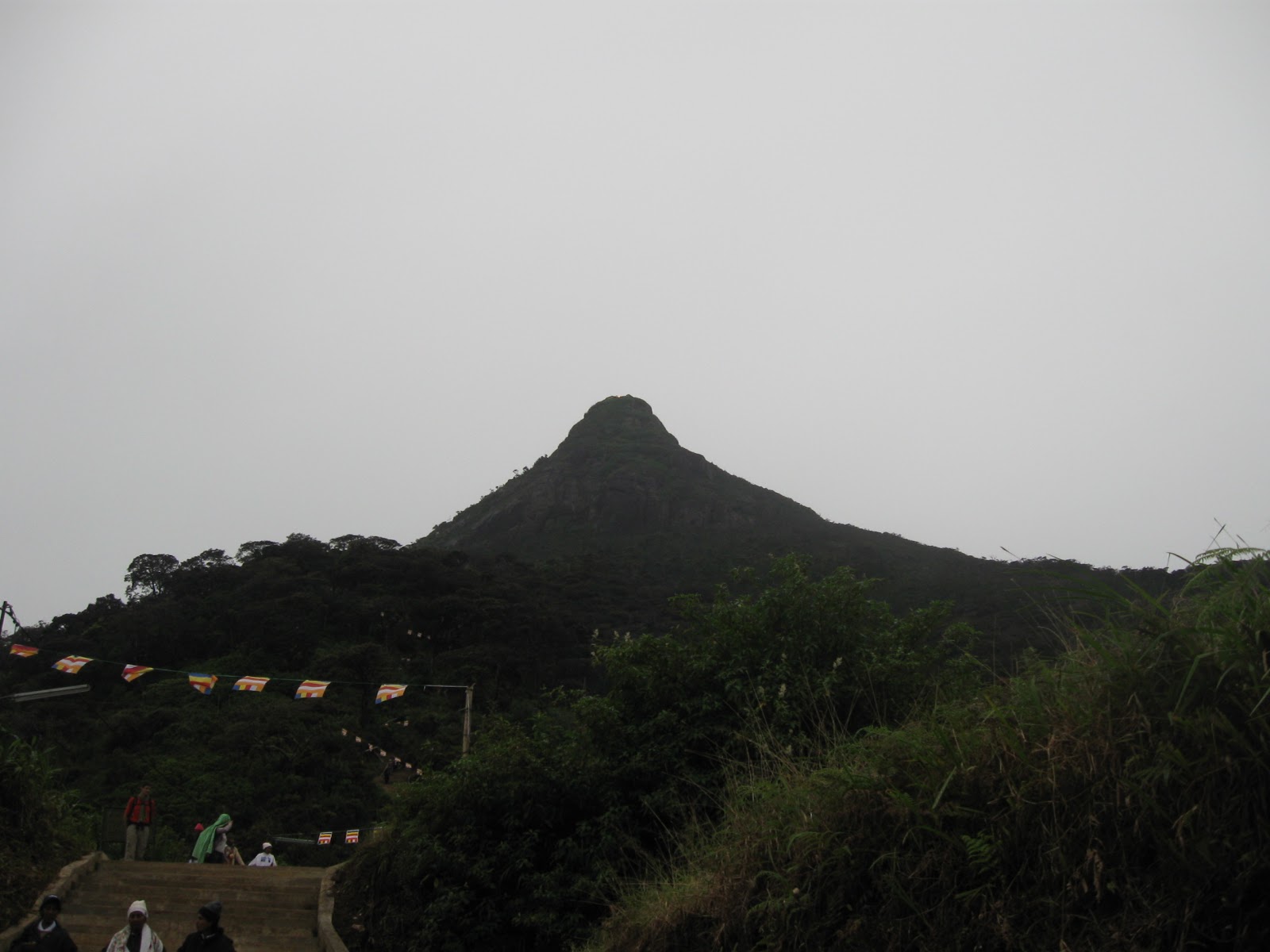
Wednesday night, I set out for Sree Pada/Adam’s Peak with Alex, Erica, and Malik. Although this is not the tallest mountain in Sri Lanka, it is the highest point in its immediate vicinity, making it seem huge. At the top, a depression in the rock is said to be the footprint of the Buddha. There is now a temple constructed around the footprint (entirely obstructing it from view), and thousands of pilgrims climb the mountain to worship. We left at night, so we could reach the top for sunrise. We started walking at 12:30, following the path marked by prayer flags and lit up by streetlights. The hike is essentially four miles of stairs, very steep stairs in some parts. It was definitely challenging and hard to believe that pilgrims of all ages make this journey. The fact that we were doing this in the middle night, having gotten no sleep, did not make it easier, but we made it to the top, where it was cold and windy, at around 4:30 with one and a half hours to kill before sunrise. We put on all of our layers and huddled together inside the temple to try and stay warm and get some rest while pilgrims prayed all around us and other tourists milled around. Unfortunately, it was cloudy so we couldn’t see the sunrise, but there were still some incredible views. The hike down, although not as challenging as the hike up, was still difficult and reached the van, exhausted and sore.
Adam's Peak

Malik, Erica, and Alex getting ready to climb the steps

Watching the sky get light

Walking down from Adam's Peak

The day was not over for us yet though. Yesterday afternoon was the final tea, where we all got dressed up in sarees and came to the ISLE Center with our families to drink tea, eat cake, take pictures, and say goodbye.
In my saree with my amma and appacci

Somehow the four of us who had climbed Adam's Peak managed to stay awake for the tea

Although most people are going home today, I’m sticking around for a couple more weeks. My parents are arriving this afternoon, and I’m going to Colombo to meet them and see Sri Lanka as a tourist.

Saturday, November 26, 2011

Research in Nuwara Eliya


I’m back in Kandy now, after spending 11 days in Nuwara Eliya, learning about land use in the area. The first week was great. I got out almost every day to interview fruit and vegetable farmers, researchers, or home gardeners. The second week, although still interesting, was not as enjoyable as it started raining on Sunday and still had not stopped when I left this morning, 7 days later. I used to laugh at Sri Lankans who complain about Nuwara Eliya being cold, but I understand now. The first week, when it was sunny, I got cold in the evenings and ended up sleeping in the fleece jacket I bought on my second day there. The second week, I was always cold, day and night. It makes me worry about what’s going to happen when I return to Massachusetts and then Maine in January.
One thing that I loved about this past week and a half is that I got to spend every day going outside into some beautiful place, although I did get a little bit sick of seeing leek and carrot fields. Perhaps what surprised me most during my research is that very few people seemed to think that organic is possible. Everyone wanted to reduce their use chemicals, but even people at the Agricultural Research Station said that without chemical fertilizers and pesticides, the farms just won’t be productive.
The most eventful thing that happened to me was having my food stolen by monkeys at Hakgala Botanic Gardens. I was sitting in a small pavilion, eating strawberries, when all of a sudden three monkeys appeared and grabbed the (almost empty) container of berries. They were sitting in the door, seeming to be expecting me to give them more food. Wanting to get out of there before they came after more of my stuff, I climbed over the waist-high wall rather than walk through the doorway guarded by monkeys. Later, they tried to take my mango, and as I was putting a plastic bag, full of trash into my backpack, one grabbed the bag out of my hand and climbed up a tree to share it with the others. I let them keep it and continued walking around the gardens.

Vegetable farms

All of the terraces in the background are vegetables, mostly carrots, leeks, potatoes, beets, and cabbage

The view from Hakgala Botanic Gardens

Old tea plants in Hakgala Botanic Gardens

Ambewela Dairy Farm

Tuesday, November 15, 2011

Finishing the Second (and Second to Last) Session


Although the past week has not been the most interesting of weeks, it sure has been busy. Classes for Session 2 ended on November 4, and then we had a week for exams, papers, and final projects, while also preparing for independent study. I spent the week reading, writing, photographing plants for a botany project, and attempting to study for my history exam. Needless to say, it’s hard to study for an exam, which requires two detailed essays, for a class that covered 450 years of history in 5 weeks and has no reading list. It was slightly reassuring, though, when the professor’s assistant told us that the professor knows how to deal with students like us (i.e. Americans). I was able to take plenty of study breaks, however, to play hide and seek, run and catch (aka tag), and Carrom with my mallis and nangiis. We also had our dancing and drumming concert on Friday. We definitely made a fair number of mistakes during the performance, but it wasn’t a disaster, which means it exceeded my expectations.

After unsuccessfully searching the Peradeniya Botanical Gardens for a breadfruit tree (needed a picture for my botany project), I discovered that there was one in my backyard.

Practicing Dance in the Hall

Nervously awaiting the start of our performance

I’m now in Nuwara Eliya, getting ready to start research for my independent study. I’m going to be studying the environmental impacts of agriculture in the Nuwara Eliya District, and starting tomorrow I’ll be going out into the fields with officers from the Agricultural Research Station here to talk to farmers about their use of fertilizers, pesticides, irrigation, and erosion control. I’ll be staying here for 2-3 weeks, living with a very nice family (a grandmother, mother, and two daughters) before returning to Kandy to write my paper.
It’s hard to believe that I only 5 weeks left until the program ends (I’ll be staying in Sri Lanka for an extra 2 weeks, traveling with my family). There are definitely parts of me that are ready to go home, but I know that I’m going to miss being here—I’ve gotten close to my host family (I’m going to miss them just spending 2 weeks in Nuwara Eliya), and Sri Lanka really is a beautiful country—there just isn’t enough time to see everything here.

Some pictures from my home in Kandy:

The orphaned baby squirrels my family is keeping until they are large enough to fend for themselves

Nangii sitting on the porch at Attamma's house